This is my operations manual for 2013.
Showing posts with label organic farming. Show all posts
Tuesday, January 1, 2013
Tuesday, March 6, 2012
Tuesday, February 14, 2012
Pea Shoots - Delicious, Nutritious and Easy to Grow
I began experimenting with growing pea shoots a few years ago as a transitional crop to bridge the gap between the last of the winter greens and new spring crops. I buy dwarf gray sugar peas, garnish type, from Johnnys Seeds. A 5 lb. bag costs $17.60. I can sow about 8 flats with 5 lbs. of seeds and sell they for $12.00 per flat. Pretty good ROI.It took several attempts to work out the kinks in my method. This is how i do it.
- I use standard web trays lined with landscape fabric to keep the soil from running out the bottom. Newspaper would work as well.
- I fill the trays half way with my standard worm casting
and granite sand seed starting mix. I sprinkle 2 cups of pea seeds evenly over the surface and press them firmly into the soil. I used to cover them with soil but i found that because the seeds are so close together they would push up large masses of soil which were hard to deal with. - I water them thoroughly.
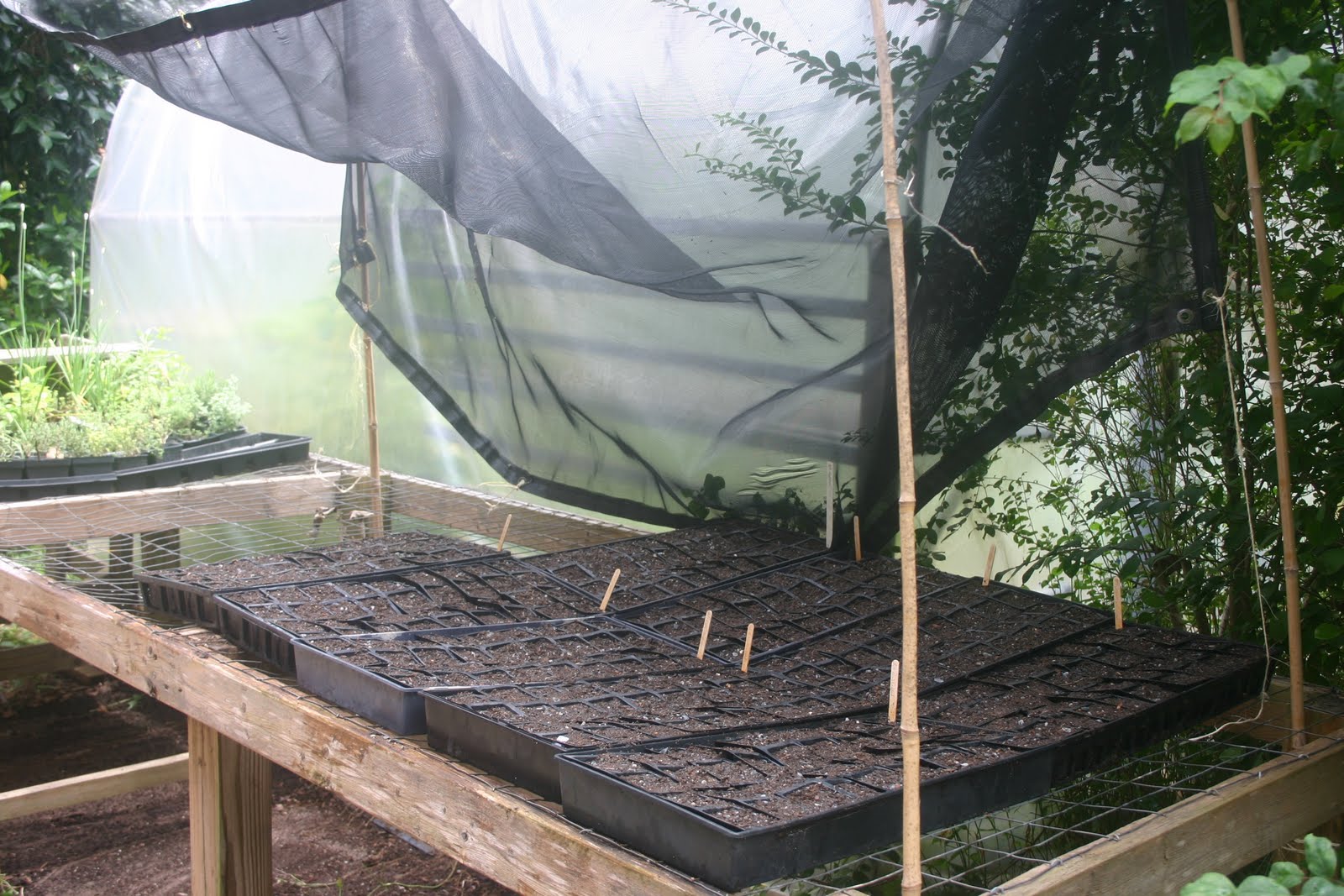
- I place them on the table under the grow light and cover the trays with plastic to retain moisture. The grow light provides heat that encourages germination. When the weather is warmer i place them in the hoop house. I check them daily and water when needed to keep the seeds moist.

- They will germinate in about 7- 10 days at which time I remove the plastic.
- They will be ready to harvest in about 3 more weeks when the shoots are 3-4 inches tall. If i cut them off above the first couple of leaves i can sometimes get enough regrowth for another harvest.
Packed with vitamins A[1], C[2] and folic acid[3], Pea Shoots are a delicious, nutritious modern slant on the classic British garden pea. Lyndel Costain, B.Sc.RD, award winning dietitian and author of SuperNutrients Handbook, says, “Pea Shoots are a nutritious leaf with high levels of vitamin C and vitamin A. A 50g bag of these tasty greens offers more than half of the RDA for vitamin C, a quarter of the RDA for vitamin A and significant amounts of folic acid. It is great news that this healthy and simple to prepare British vegetable leaf is readily available to consumers.”
source - peashoots.com
That's it! Easy peasy :)
Tuesday, August 9, 2011
Much Ado About Beets or It's Fall Planting Time
I noticed in Johnny's Seed catalog last week that they have little graphs for each vegetable variety that show what soil temperatures are best for germinating seeds. I have never seen them before. I do not know if they are new or I am just unobservant.
This is extremely useful information, especially this time of year when seeds for fall crops need to be sown and it is still hotter than the hinges of hell. Take beets. In the past i have sown beets in the ground in mid to late September. I rarely got beets until the following spring because they ran out of warm growing days before the roots formed. Well, Johnny's little graph tells me that they germinate best when the soil temperature is 86º. That is quite warm. I went out a little earlier with my instant read meat thermometer and did some research. Of course i have no idea how accurate my thermometer is so take this with a grain of salt (whatever that is supposed to mean). Bare soil in the sun was about 87º. Soil under wheat straw mulch in the sun was about 82º. Soil under the lima bean trellis where the sun never shines directly was about 77º. Clearly there are differences depending on the environmental conditions. So the conclusion is that I need to plant my beets this week! The seed package says they will be ready in 55 days so i should have beets by mid to late October. Yiippeee! I had planned on planting carrots this week but carrots ideal soil germination temperature is 77º so i will wait a while before planting them.
Today i planted several different brassicas in flats. Broccoli, collards, mustard, kale, napa cabbage. Self-seeded mustard came up in the garden several weeks ago so I know it will germinate fine. According to Johnny's graph, and my personal experience, broccoli likes cooler soil. Collards, napa cabbage and kale like it hot. I set up some shade cloth to provide some shade for the flats. They will germinate in 3 days then i will remove the shade cloth and watch them grow.
2 weeks ago i seeded arugula in the ground. It is up and growing well in a bed partially shaded by other tall plants. Komatsuna 'Summerfest' i seeded last week and it is up and doing well. Tokyo Bekana greens and Tokyo market turnips that is sowed on Sunday germinated last evening. That was quick.
Apparently there is a worldwide shortage of Hakurei Turnip seeds. I cannot find a source now. Johnny's rep told me it would be late this year before they would have any. If anyone knows of a source for it please share with me.
Thanks.
Thursday, June 23, 2011
Letter from a Neighbor - Summer Update from The Funny Farm

Yesterday a neighbor, whom we have not yet met, left this lovely letter in our mailbox. This is what it says:
Dear Neighbor,
just wanted you to know how much I enjoy your lovely garden. It always gives me Joy when I walk by. :) Thanks for tending to all the plants and making a difference in this world.
I have never had a green thumb but I am slowly starting to take care of a few small plants.
Take Care,
Srel (??)
We really appreciate that she took the time to let us know. It really warms our hearts to know that some people appreciate our work.
Here is what she sees.

Flowers along the street.

The view from the street towards our house.

Our intern Katherine weeding the green beans.

Winter squash trellis and cucumber teepees.
Happy Summer y'all. Keep on Growing!
Thursday, March 31, 2011
Mindful Weeding- Learning From My Mistakes

I knew i shouldn't do it but i did it anyway. Back in February we had several weeks of unseasonably warm weather and i wanted to get some seeds planted before i left town for a week to visit my mom. Rain was in the forecast the day before i needed to leave. I tilled in the rye grass cover crop in the morning and left the turned up plants to dry in the sun. I knew that there were rye plants buried just below the surface and i knew that the rain would encourage them to re-root. I was in a hurry to get the seeds in the ground so i raked out the bed as best i could the following day and planted Tokyo Bekana and turnip seeds.
Sure enough when i returned from my trip the seeds had germinated and the rye was starting to come back. It was not until a couple days ago that i made time to do something about it. I spent 2 hours pulling the rye grass out of the bed. I am very particular about how i pull weeds. Some people mindlessly yank at them, paying scant attention to what they are doing. I want be sure i get the whole root out of the ground because i do not want to go back later and do it again. I can tell by the sound if someone is pulling weeds correctly. If you are just tearing the tops off it makes a popping sound. If you are doing it correctly the sound is more like an extended rrriiipppping sound as the roots come loose from the soil.
What I Learned by Practicing Mindful Weeding
During those 2 hours i spent on hands and knees in intimate contact with the soil food web i learned several things by being in the moment and observing what was going on before my eyes.
- The seedlings that looked good walking by, on close examination are showing signs of a magnesium deficiency. They have a slight interveinal chlorosis with some small necrotic (dead) spots on the leaves. I will drench them with a solution of epsom salts ( magnesium sulfate) mixed with fish fertilizer to correct the deficiency.
- The earthworms are thriving!. Every time i pulled up a clump of rye there were happy worms wiggling around.
- The clover i left to grow in the paths are heavily colonized by the nitrogen fixing rhizobium bacteria sharing it with the surrounding plants.
- Baptisia australis can be propagated by root cuttings. I dug some out of the beds and moved them to another location in the fall. New plants are emerging where pieces of root were left in the ground.
- Morning glory and potato vine (a cousin) are becoming an increasing problem in this part of the garden. I need to stay on top of it to keep it from going to seed this year.
Practice Mindful Weeding y'all.
Thursday, January 20, 2011
The Pedagogy of Transformation - Powerful Words from a Visionary Farmer

The streets were jammed with buses, cars and people headed to the 25th annual Dr.
Martin Luther King Jr. National Holiday celebration at the MLK Center in Atlanta
Monday as I made my way to the fruit tree planting at the new 4 acre Wheat Street
Gardens Urban Farm. As I got out of my truck i could hear singing coming from the celebration at the King Center, 2 blocks away. I got there a little after the posted start time of 10:00 a.m. I was astounded to see a swarm of people already working away, hauling compost, planting trees,
bulbs and shrubs and wheeling mulch all around the site. There were old people, middle aged people, young adults and lots and lots of kids. Families were gathering together to take pictures of each other planting trees on this important day. Every one was joyous and the mood was infectious.
I tracked down Rashid Nuri and Eugene Cook, the masterminds behind this wonderful project, to see what they would like me to do. I commented about how awesome it was to see so many people there and Rashid said he was too. He said that as an organization they had not done any promotion of the event to the greater community. The plants were donated by ALFI, the Atlanta, Local Food Initiative, so some people involved in that group knew about and came out. Other people heard about it through the grape vine and many people who came for the MLK Day festivities happened by and decided to pitch in. I would estimate that there were over 200 people working during the course of the day. I would also say that 90% of them had never planted a fruit tree or shrub before.

I was assigned the task of planting the blackberries and raspberries. I worked with a couple of college aged women and a man and his little boy. The little boy asked what it was we were planting. I told him they were raspberries. His dad asked me when they would start producing fruit. I said it would be next year before there would be any fruit to pick. He said " Hey son, we will be about to come back next year to see and taste the fruits of our work here today". The little boy was excited by that prospect. The 2 women said they lived a few blocks away and had stumbled upon the farm while out walking one day. They were interested in finding out about other opportunities to contribute in the future. I showed them how to plant the berries properly and we all pitched in to get the job done.
As we were finishing up the planting a group of 3 or 4 boys and girls about 9 or 10 years old started showing up with buckets full of wood chips. Back and forth up and down the hill they went bringing bucket after bucket. One of the boys asked if what was in the bucket was fertilizer? I said no it was mulch. He asked, "well what is fertilizer?" then answered himself with "manure". I told him the microbes in the soil would eventually break down the mulch to feed the plants. "humus?" he asked. I said yes it would eventually turn into humus. "Oh, you mean decay". Yes, young man, you totally get it.

After we finished up that project I found Rashid to let him know we were done and i told him about the conversation with the kids. He got a big smile on his face and he said that this farm was all about the pedagogy of transformation. Teach people to transform themselves and they will go out and transform their community. This process made a huge leap forward that day. There is no doubt in my mind that many people were inspired to go back to their homes and communities and start growing some food. I imagine for many people this was an experience they will never forget. I know I will not.

Here some links to information about Rashid and Eugene's work at Truly Living Well Natural Urban Farms. and their partner in this effort the Wheat Street Baptist Church Foundation.
Truly Living Well Center for Natural Urban Agriculture
Wheat Street Baptist Church
Wheat Street Gardens Urban Farm
Wednesday, November 3, 2010
Choosing Varieties that Work in our System
Each year we trial new varieties of crops in the never-ending search for those that produce well for us. We are looking for ones that can withstand the extremes of high temperature, humidity and often low rainfall (drought) that we experience in the summer here in Georgia. Our climatic conditions can put great stress on our crops making them more susceptible to insect and disease pressures. Additionally, night temperatures in the 70's and daytime temperatures in the 90's for days on end cause plants to go into survival mode. They stop producing flowers and fruit.
We grow some hybrid varieties and some open-pollinated varieties. Many hybrids have been bred to withstand disease or insect infestations. Many open-pollinated and heirloom varieties do not have these traits although some do. We take this into consideration when making our choices. We look for varieties that have been grown successfully in our area for a long time. We want varieties that taste good and produce a good yield for a long period of time.
Here are a few examples of how we make those decisions.
We will start with zucchini and squash. We stopped growing yellow squash for 2 reasons. The first is that most of the other growers at our markets grow it so we do not need to compete with them. Additionally we have not found a variety that produces well for us. Insects and diseases always take them out early. This year we decided to focus on zucchini. We planted 2 heirloom varieties from Europe. One was ronde de nice, a French variety, and the other was costata romanesco, an Italian variety. Both varieties showed good resistance to disease and insect pests. We only lost a couple of plants to the dreaded squash vine borer. The ronde de nice plants grew well, the fruit was tasty and looked good but produced very little fruit. The costata romanesco grew well and produced great tasting fruit over a long period of time. That variety also produced plentiful male blossoms which we were able to harvest and sell to a restaurant. Guess which variety we will be growing next year. The previous year we had success with an old open pollinated variety called simple long grey. We will be adding it back to the mix next year as well. Delicata is an open pollinated variety that does well for us too.
Next are tomatoes. Our main tomato variety is Big Beef, a hybrid. It consistently produces tasty, good sized fruit and is pretty resistant to the ubiquitous early blight we get every year. We also do well with Tomatoberry,
another hybrid introduced by Johnnys Seed a couple of years ago. It produces strawberry sized and shaped fruit that are very tasty. It excels late in the summer when other varieties have given up. We still have one plant that is cranking out lots of fruit in November. Amana Orange is an heirloom variety that is my favorite tomato for flavor.
It does not produce a lot of fruit but it is a market favorite so we can get a premium price for it all summer. This year we tried San Marzano. The plants grew strongly at first but were the first to succumb to the blight. We will be looking for another paste type variety next year, probably we will go back to Roma. We also tried Sungold II. It did terribly. Another one we like a lot is Eva Purple Ball, another heirloom variety that does well. Flavorful and crack resistant, it produces well too.
The final example is butterbean. We love them but had not devoted space for them in the past. This year we planted a short row of Violet's Multicolored. Here is the description from Southern Exposure Seed Exchange:
They lived up to the description in every way except 1. They were not even close to being semi-bush. The vines grew to be 12' long. It was fortuitous that i did not read the description on the package again before planting so i built a tall trellis for them to grow on.
We saved the beautiful seeds for planting next year.
We grew several other crops too. Marketmore cucumbers did great for us. Provider bush green beans have done well in the past but struggled this year with the heat and drought. We have a difficult time with peppers. This season we will continue to hunt for pepper varieties that will do well for us. We will be trying new techniques to protect the eggplants from flea beetles and potato beetles.
I read a research study yesterday about the declining nutritional quality of fruits and vegetables over the last 50 years. The conclusion of the study was that hybrid varieties that were bred to produce a large yield at the expense of nutritional value was a big factor in this trend. We will be taking that into consideration when we are salivating over seed catalogs in the next month or two.
After all we are what we eat!
We grow some hybrid varieties and some open-pollinated varieties. Many hybrids have been bred to withstand disease or insect infestations. Many open-pollinated and heirloom varieties do not have these traits although some do. We take this into consideration when making our choices. We look for varieties that have been grown successfully in our area for a long time. We want varieties that taste good and produce a good yield for a long period of time.
Here are a few examples of how we make those decisions.
We will start with zucchini and squash. We stopped growing yellow squash for 2 reasons. The first is that most of the other growers at our markets grow it so we do not need to compete with them. Additionally we have not found a variety that produces well for us. Insects and diseases always take them out early. This year we decided to focus on zucchini. We planted 2 heirloom varieties from Europe. One was ronde de nice, a French variety, and the other was costata romanesco, an Italian variety. Both varieties showed good resistance to disease and insect pests. We only lost a couple of plants to the dreaded squash vine borer. The ronde de nice plants grew well, the fruit was tasty and looked good but produced very little fruit. The costata romanesco grew well and produced great tasting fruit over a long period of time. That variety also produced plentiful male blossoms which we were able to harvest and sell to a restaurant. Guess which variety we will be growing next year. The previous year we had success with an old open pollinated variety called simple long grey. We will be adding it back to the mix next year as well. Delicata is an open pollinated variety that does well for us too.Next are tomatoes. Our main tomato variety is Big Beef, a hybrid. It consistently produces tasty, good sized fruit and is pretty resistant to the ubiquitous early blight we get every year. We also do well with Tomatoberry,
another hybrid introduced by Johnnys Seed a couple of years ago. It produces strawberry sized and shaped fruit that are very tasty. It excels late in the summer when other varieties have given up. We still have one plant that is cranking out lots of fruit in November. Amana Orange is an heirloom variety that is my favorite tomato for flavor.
It does not produce a lot of fruit but it is a market favorite so we can get a premium price for it all summer. This year we tried San Marzano. The plants grew strongly at first but were the first to succumb to the blight. We will be looking for another paste type variety next year, probably we will go back to Roma. We also tried Sungold II. It did terribly. Another one we like a lot is Eva Purple Ball, another heirloom variety that does well. Flavorful and crack resistant, it produces well too.The final example is butterbean. We love them but had not devoted space for them in the past. This year we planted a short row of Violet's Multicolored. Here is the description from Southern Exposure Seed Exchange:
80-90 days [Banks County, GA, saved by 4 generations of Violet Brady Westbrook’s family.] A rainbow of colors – cream, beige, red-brown, and violet-purple, with speckles and swirls. Small seeds have great flavor, good both fresh or dried. 3-5” pods. Semi-bush plants have good disease- and drought-resistance.
They lived up to the description in every way except 1. They were not even close to being semi-bush. The vines grew to be 12' long. It was fortuitous that i did not read the description on the package again before planting so i built a tall trellis for them to grow on.
We saved the beautiful seeds for planting next year.We grew several other crops too. Marketmore cucumbers did great for us. Provider bush green beans have done well in the past but struggled this year with the heat and drought. We have a difficult time with peppers. This season we will continue to hunt for pepper varieties that will do well for us. We will be trying new techniques to protect the eggplants from flea beetles and potato beetles.
I read a research study yesterday about the declining nutritional quality of fruits and vegetables over the last 50 years. The conclusion of the study was that hybrid varieties that were bred to produce a large yield at the expense of nutritional value was a big factor in this trend. We will be taking that into consideration when we are salivating over seed catalogs in the next month or two.
After all we are what we eat!
Sunday, October 31, 2010
Gardening in 3-D: Delight in Disorder

One of the most important strategies we employ is to encourage biodiversity. By doing so we can partner with a wide variety of organisms who will help us with pest control. Our farm looks like a mess to most people (including some of our neighbors). We have lots of wild looking "overgrown" areas. What appears to be chaos has an invisible order to it. These areas are home to birds, snakes, possums, toads, tree frogs, squirrels, rabbits, rats and chipmunks ( i believe my totem animal is a chipmunk). Yes, we have to share some of our bounty with them but we feel that overall we gain much more than we lose from their presence. In the past few years I have observed that birds in particular play an important role in keeping pest insects at bay. I see eastern towhees cruising close to the ground, scratching in the litter and mulch hunting for insects. I watched goldfinches eat the sunflower petals and then perch on the long beans and eat the aphids feeding on the beans. I have seen mockingbirds snatch tomato
worms right out of the fruit.We purposefully plant a wide variety of flowering plants that attract beneficial organisms including both pollinators and predators of pest insects. One of the first things we did when we got to the Funny Farm was to establish our bugscaping (aka farmscaping) beds. This spring we were able to divide the plants from that bed and spread them into other parts of the garden. Each year we have found more and different species of predatory insects working side by side with us. We help them by providing food and habitat and they help us by controlling pests on our crops.

This year I made a concerted effort to move away from the typical agricultural model of planting crops in rows. I wanted to mix things up to maximize diversity within my garden beds. Mother nature does not plant in rows. The goal was to make it harder for insect and disease pest to find their targets increasing the chances of our obtaining a yield. Here in the south squashes and zucchinis are difficult to grow organically. There is a large variety of insect and diseases that prey on them, the most devastating of which is the squash vine borer. When I planted my squash in a row the momma moth would cruise down the row happily laying her eggs on each plant. Soon one by one the plants would wilt and die leaving me squashless. We decided to try and outsmart her by confusing her.
We planted our squash plants all over the place, between the tomatoes, among the zinnias, beside the pole beans, among the basil. This strategy worked pretty well. She found a few plants but through constant diligence I was able to find and destroy the larvae before they did serious damage and we had a decent yield of squash.We also also made better use of 3 dimensional space in the garden by utilizing stakes, teepees and trellisses. We plant our tomatoes 4' apart and tie 2 vines to metal tee post that has a 8-10' tall bamboo pole attached to it. Our tomatoes grow up to the top of the poles and then cascade back down. The wide spacing allows us to plant lower growing plants between them. We mixed a lot of different things between them besides the squash; bush beans which fix nitrogen, basil, zinnias, sunflowers which attract pollinators and predatory insects. We wanted to emulate a natural system as much as possible. All the different plants give off different chemical signals making it harder for pest insects to find their favorite foods. We created a similar 3-d space to a forest edge with a canopy, understory and dense layer near the ground. I saw the towhees moving from the wild woodsy spaces into the garden spaces scratching in the mulch and eating insects.
We made teepees out of bamboo poles our friend Henry brought us and grew our cucumbers and melons on them (don't be fooled by Baker Creek Seed's description of a Tigger melon. They may smell good but the taste like crap) . Between the widely spaced teepees we planted okra to fill the void. the teepees were shaped like this ^ and the okra grows like this \/. Someone said the bamboo structures reminded her of Gilligan's Island. Seem like a good model of sustainability to me.

This summer was hot and dry. We had our share of insects and diseases. Some crops failed but most did quite well. All in all we are very satisfied with our new 3 dimensional strategy and will be refining it next summer.
Over 1800 lbs. harvested from June until now on 1/8th acre ain't too shabby.
Monday, October 11, 2010
A Recap of what has been going on at The Funny Farm these past few months
Our goal for this year is to double our production compared to last year. We produced 1600 lbs. of fruits and vegetables last year. We record our production from June to June since that was the month we started going to our first farmers market in 2009. When we harvest for market and for Vegetable Husband this Wednesday we will surpass our total for all of last year, 4 1/2 months into our 2010 harvest year. We have much more growing now than we did at this time last year. We will be using row covers much more extensively this winter so we can keep production going all winter with a little luck. I am encouraged that we are on track to meet our goal.We have employed several strategies to reach this rather lofty goal. I will give an overview here of what they are and I will explain in greater detail how we implemented them in future posts. I promise...really I will!

- First on the list was getting a soil test. We knew from observation of our crops that we were deficient in magnesium. We were not getting the production we thought we could get. The results of the test confirmed our suspicions. This will be the subject of our next post
- Increasing biodiversity was next. We worked on improving habitat for beneficial organisms both above ground and in the soil food web. This helped us by reducing insect and disease pressure. We did much more intercropping to take advantage of 3 dimensional space and to try to confuse potential insect pests minimize the spread of disease organisms.
- We refined our choices of crops and varieties we would grow to find better matches for our particular growing system.
- We utilized some more marginal spaces to increase our productive area utilizing methods gleaned from permaculture.
I could be wrong!
Tuesday, August 17, 2010
Fall Organic Gardening Workshop
Our fall intensive organic gardening workshop will start on Sunday September 12th and go for 4 weeks, ending on Sunday October 3rd. It meets from 1-4 p.m. here is what we will cover:
Week 1 - Organic Gardening Foundations - Soil Food Web, composting, worm composting and nutrient cycling
Week 2 - Garden planning- What to plant, When to plant it and How to plant it
Week 3 - Pest control strategies - putting Mother Nature to work to control insects, diseases and weeds.
Week 4 - Incorporating Permaculture Strategies in your garden- Food forests, growing edible mushrooms, edible landscapes, rainwater harvesting
You can register by going here: http://fallorganicgardeningworkshop.eventbrite.com
Space is limited to 10 so don;t delay.
Week 1 - Organic Gardening Foundations - Soil Food Web, composting, worm composting and nutrient cycling
Week 2 - Garden planning- What to plant, When to plant it and How to plant it
Week 3 - Pest control strategies - putting Mother Nature to work to control insects, diseases and weeds.
Week 4 - Incorporating Permaculture Strategies in your garden- Food forests, growing edible mushrooms, edible landscapes, rainwater harvesting
You can register by going here: http://fallorganicgardeningworkshop.eventbrite.com
Space is limited to 10 so don;t delay.
Tuesday, January 19, 2010
The Barley Project- Using Premaculture Principles to make decisions about growing food
I have been observing and analyzing the space beside the barn for several years now to determine what will be the best use of it to produce a good yield. Underlying the space is the drain field for our septic system. The previous owner used mowing as their maintenance strategy for the space. The lower edge is the property line. Beyond that on the neighbor's property are fairly mature canopy trees. Along the edge are some understory trees and shrubs which are good habitat for birds, small mammals, snakes and insects. Some of the chickens hid there to escape the marauding dogs that killed one of them a couple of weeks ago.
The soil is a clay loam. It is near the bottom of a slope. It is shady in winter but sunny enough for crops in the summer. The soil stays wet in the winter and is moist in the summer even in periods of little rain. The first summer we prepared beds and grew sunflowers, zinnias and other annual flowers. They did well. The following fall we planted a cover crop of annual rye and red clover with the intention of experimenting with growing organic no-till sweet corn. This worked fairly but I do not think it is the best approach for this area. Around the edges we are planting bramble fruits and small fruiting understory trees but we can't grow woody plants in the middle because their roots could clog up the drain field. Eventually we will be building a grey water system and a composting toilet which will eliminate that constraint.
I re-read Masanobu Fukuoka's book The One Straw Revolution this fall. In it he described growing barley as a winter crop followed by another summer crop. He said this was easy. Easy is good I thought so I decided to try it on a small portion of the space to test it out. I got organic barley seed from Howe Seeds, Inc. Yesterday raked away the weed stubble and scattered the barley seed. I spread a light covering of leaves we got from our neighbor's roadside leaf bagging service to hide them from the birds and provide a little shade and moisture retention while they germinate. It is going to rain in a couple of days so the seeds should get cranking soon. The literature says they should germinate in 2 days.
Why barley?
1. We like to eat barley.
2. chickens like to eat barley
3. Barley straw makes a good mulch
4. Barley straw is used in ponds to control the growth of algae. This could become a source of income for us selling mini-barley straw bales to local garden centers.
One technique used in permaculture is to divide a property into zones that radiate out from the house which in zone zero. Zone 1 is adjacent to the house where the most intensively managed activities occur such as a kitchen garden. Zone 2 would be perennial crops. Zone 3 orchard. We have all the space we need in zone 1 activities so Whatever we do in this space will be zone 2 and 3 uses. This growing season I plan to grow an interplanting of corn, winter squash, sweet potatoes and black eyed peas. The black eyed peas, being legumes, will provide nitrogen to the other crops. We will let them grow to maturity and harvest the dry beans. The squash and sweet potatoes will be harvested at the end of their respective seasons for storage. The corn will be harvested as roasting ears and the stalks chopped at the end of the season for mulch. This combination will provide a heavy canopy over the ground to shade out weeds and retain moisture reducing the meed for intensive maintenance.
If the barley experiment works we will plant the whole space with barley next winter and follow it with the interplanting described above. I am confident it will!
What permaculture principles came into plan in arriving at this plan of action for this space?
These are defined and defined by David Holmgren, co-originator with Bill Mollison of the permaculture concept, in his book Permaculture: Principles and Pathways Beyond Sustainability
1. Observe and Interact
2. Catch and store energy - sunlight, water, sustenance, human activity
3. Obtain a yield - food, mulch, straw, income
4. Apply self-regulation and accept feedback - experiment, observe results, try again
5. Use and value renewable resources
6. Produce no waste- everything in this micro-system is used to support it
7. Design from patterns to details- We used the patterns of plant succession to design the uses of the space. Forest to understory to edge to open field
8. Integrate rather than segregate- multiple species grown together to produce a whole that is greater than the sum of the parts
9. Use small and slow solutions - small experiments will lead to a productive use for the space
10. Value diversity - we mixed different plants that will attract a diversity of other organisms and produce diverse yields
11. Use edges and value the marginal
12. Creatively use and respond to change
The soil is a clay loam. It is near the bottom of a slope. It is shady in winter but sunny enough for crops in the summer. The soil stays wet in the winter and is moist in the summer even in periods of little rain. The first summer we prepared beds and grew sunflowers, zinnias and other annual flowers. They did well. The following fall we planted a cover crop of annual rye and red clover with the intention of experimenting with growing organic no-till sweet corn. This worked fairly but I do not think it is the best approach for this area. Around the edges we are planting bramble fruits and small fruiting understory trees but we can't grow woody plants in the middle because their roots could clog up the drain field. Eventually we will be building a grey water system and a composting toilet which will eliminate that constraint.
I re-read Masanobu Fukuoka's book The One Straw Revolution this fall. In it he described growing barley as a winter crop followed by another summer crop. He said this was easy. Easy is good I thought so I decided to try it on a small portion of the space to test it out. I got organic barley seed from Howe Seeds, Inc. Yesterday raked away the weed stubble and scattered the barley seed. I spread a light covering of leaves we got from our neighbor's roadside leaf bagging service to hide them from the birds and provide a little shade and moisture retention while they germinate. It is going to rain in a couple of days so the seeds should get cranking soon. The literature says they should germinate in 2 days.
Why barley?
1. We like to eat barley.
2. chickens like to eat barley
3. Barley straw makes a good mulch
4. Barley straw is used in ponds to control the growth of algae. This could become a source of income for us selling mini-barley straw bales to local garden centers.
One technique used in permaculture is to divide a property into zones that radiate out from the house which in zone zero. Zone 1 is adjacent to the house where the most intensively managed activities occur such as a kitchen garden. Zone 2 would be perennial crops. Zone 3 orchard. We have all the space we need in zone 1 activities so Whatever we do in this space will be zone 2 and 3 uses. This growing season I plan to grow an interplanting of corn, winter squash, sweet potatoes and black eyed peas. The black eyed peas, being legumes, will provide nitrogen to the other crops. We will let them grow to maturity and harvest the dry beans. The squash and sweet potatoes will be harvested at the end of their respective seasons for storage. The corn will be harvested as roasting ears and the stalks chopped at the end of the season for mulch. This combination will provide a heavy canopy over the ground to shade out weeds and retain moisture reducing the meed for intensive maintenance.
If the barley experiment works we will plant the whole space with barley next winter and follow it with the interplanting described above. I am confident it will!
What permaculture principles came into plan in arriving at this plan of action for this space?
These are defined and defined by David Holmgren, co-originator with Bill Mollison of the permaculture concept, in his book Permaculture: Principles and Pathways Beyond Sustainability
1. Observe and Interact
2. Catch and store energy - sunlight, water, sustenance, human activity
3. Obtain a yield - food, mulch, straw, income
4. Apply self-regulation and accept feedback - experiment, observe results, try again
5. Use and value renewable resources
6. Produce no waste- everything in this micro-system is used to support it
7. Design from patterns to details- We used the patterns of plant succession to design the uses of the space. Forest to understory to edge to open field
8. Integrate rather than segregate- multiple species grown together to produce a whole that is greater than the sum of the parts
9. Use small and slow solutions - small experiments will lead to a productive use for the space
10. Value diversity - we mixed different plants that will attract a diversity of other organisms and produce diverse yields
11. Use edges and value the marginal
12. Creatively use and respond to change
Tuesday, December 29, 2009
January Workshops

We are having a series of workshops next month. Start your garden season off right with our Garden Planning workshop on Sunday January 10th. The time to begin you early spring planting is coming soon. Join our Starting Plants from Seeds workshop on Sunday January 17th. There are still a few spaces available for our 6-week intensive organic gardening workshop starting on Sunday January 31st. You can see a list of all our upcoming workshops on our website www.funnyfarmatl.com .
Thursday, December 3, 2009
Winter 2010 6-week Intensive Organic Gardening Workshop

We are proud to announce that our new 6 week organic gardening workshop. Registration in now live.
This is a hands-on workshop Whether you are a beginner or an experienced gardener wanting to convert from conventional to organic methods, whether you have a sunny townhouse patio or a 3 acre lot, this class will put you on the path to taking control of your food future.
Classes meet every other Sunday from 1-4 p.m. Starting January 31st & ending April 11th
Topics covered
The workshop is limited to 10 people so register today.
Classes meet every other Sunday from 1-4 p.m. Starting January 31st & ending April 11th
Topics covered
- Make compost and manage your soil using free, local organic inputs
- Grow vegetables from seed
- Put biodiversity to work to reduce or eliminate pests
- Use perennial vegetables and fruits as part of a permaculture garden
- Use mushrooms to recycle nutrients and produce high quality protein
- Harness the power of worms to turn your kitchen scraps into nutrient rich worm castings
- Plan your garden to get maximum output of nutritious food
The workshop is limited to 10 people so register today.
Wednesday, September 5, 2007
An exciting day at the Funny Farm

Today we planted our first crops. We prepared the beds by tilling in some of our gourmet worm compost, kelp meal and granite sand for mineral nutrients. We planted beds of basil, cilantro, chives, japanese snow turnips, and Scarlett Queen turnips. Our broccoli, red cabbage and lettuce plants are growing well in flats and will be ready to plant soon.
I tilled in organic fertilizer and kelp meal in the bed that is destined to have Top Hat blueberries. Top Hat is a new variety that is self-fertile that was developed at Oregon State U. The plants are said to grow 2' high and wide making them ideal candidates for pot culture. They promise to be a great addition to urban farming. The berries are supposedly almost as large as Rabbiteye. We'll see next spring.
Subscribe to:
Posts (Atom)